Corneal Thickness Test Birmingham – Digital Pachymetry
Measuring corneal thickness as part of specialist glaucoma and eye-pressure assessment
Pachymetry is the measurement of the thickness of the cornea, the clear window at the front of the eye.
The thickness of the cornea is important because it can influence the interpretation of an eye-pressure measurement. A thicker cornea may produce a higher pressure reading, while a thinner cornea may produce a lower reading than might otherwise be expected.
However, corneal thickness does not simply provide a mathematical correction or reveal an exact “true” eye pressure. Instead, the measurement is considered alongside the eye pressure, optic nerve appearance, OCT imaging, visual-field results and other clinical findings.
Why is corneal thickness important in glaucoma assessment?
Eye pressure, or intraocular pressure (IOP), is an important risk factor for glaucoma, but the pressure reading should never be considered in isolation.
Knowing the central corneal thickness helps the clinician interpret the pressure measurement more appropriately and contributes to the overall assessment of patients with:
- raised eye pressure or ocular hypertension;
- suspected glaucoma;
- established glaucoma;
- unusual or borderline pressure readings; or
- a difference in pressure between the two eyes.
A thin or thick cornea does not by itself mean that glaucoma is present. Likewise, a normal corneal thickness does not exclude glaucoma.
A proper glaucoma assessment therefore considers the pressure measurement together with the health of the optic nerve and the results of other investigations. NICE recommends a comprehensive approach to glaucoma assessment that includes Goldmann-type applanation tonometry, optic nerve assessment, visual-field testing and assessment of the drainage angle where appropriate.
How is corneal thickness measured?
Corneal thickness is measured in micrometres, which are thousandths of a millimetre.
The test is quick and painless.
At Edgbaston Eye Clinic, corneal thickness can be assessed as part of a detailed glaucoma or ocular-hypertension investigation.
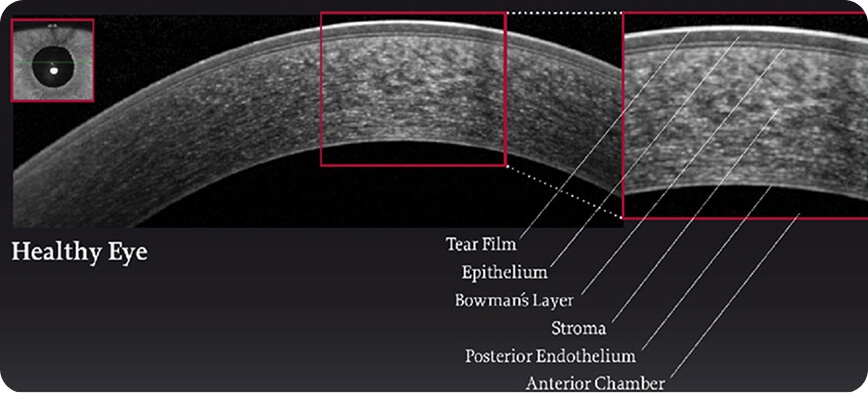
The clinic is also equipped with the Heidelberg SPECTRALIS Anterior Segment Module, which provides high-resolution OCT imaging of the cornea and can assist with the assessment of corneal thickness and corneal structure. Heidelberg Engineering specifically describes the module as providing detailed imaging of the individual corneal layers and supporting corneal-thickness assessment.
Why is pachymetry not used on its own?
Pachymetry is only one part of the clinical picture.
For example, two patients may have the same measured eye pressure but very different optic nerves, visual fields, corneal thicknesses and overall glaucoma risk.
This is why specialist assessment may also include:
- Goldmann applanation tonometry;
- optic nerve examination;
- Heidelberg SPECTRALIS OCT imaging of the retinal nerve fibre layer and ganglion cells;
- Humphrey visual-field testing;
- gonioscopy;
- and comparison with previous measurements.
The aim is not simply to obtain a pressure number, but to understand whether the eye is healthy and whether there is evidence of glaucoma or an increased risk of developing it.
Digital pachymetry at Edgbaston Eye Clinic
At Edgbaston Eye Clinic in Birmingham, corneal thickness measurement forms part of our specialist assessment of glaucoma, ocular hypertension and selected patients with unusual or borderline eye-pressure readings.
The results are interpreted alongside the rest of the clinical examination rather than being used as a simple pressure-correction calculation.
Edgbaston Eye Clinic
The Consulting Rooms
38 Harborne Road
Edgbaston
Birmingham
B15 3HE