


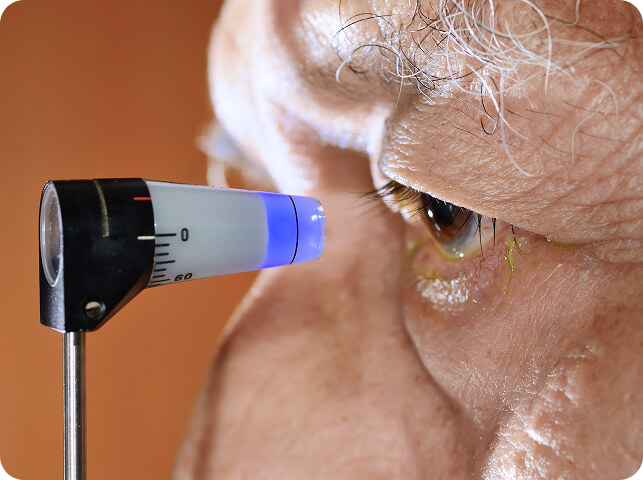
Eye Pressure Measurement Birmingham – Goldmann Applanation Tonometry
Accurate intraocular pressure measurement at Edgbaston Eye Clinic
The pressure inside the eye is known as intraocular pressure, or IOP.
Measuring eye pressure is an important part of assessing patients for glaucoma and ocular hypertension, but a pressure reading on its own does not diagnose glaucoma.
At Edgbaston Eye Clinic in Birmingham, eye pressure can be measured using Goldmann applanation tonometry (GAT), a well-established contact method widely used in specialist glaucoma assessment.
What is Goldmann applanation tonometry?
Goldmann applanation tonometry measures eye pressure by gently assessing the force required to flatten a very small area of the cornea.
Unlike the familiar air-puff test, Goldmann tonometry does not use a puff of air and is considered the gold standard for eye pressure measurement.
A small amount of anaesthetic eye drop is normally placed into the eye first, together with fluorescein dye. The Goldmann instrument is then brought gently towards the front surface of the eye while you sit at the slit lamp.
The measurement itself usually takes only a few seconds and should not be painful.
Why is accurate eye-pressure measurement important?
Raised intraocular pressure is an important risk factor for glaucoma, but there is no single pressure reading that tells us whether glaucoma is present.
Some patients can have relatively high eye pressure without optic nerve damage, known as ocular hypertension.
Conversely, some people develop glaucoma even though their measured pressure is not particularly high. The Royal College of Ophthalmologists notes that a significant proportion of patients with glaucoma can have pressures below 21 mmHg.
This is why eye-pressure measurement should be interpreted together with findings such as:
- optic nerve appearance;
- OCT imaging;
- visual-field testing;
- corneal thickness;
- gonioscopy;
- family history and other risk factors; and
- previous pressure measurements.
Why might my eye pressure be measured more than once?
Eye pressure is not completely constant throughout the day.
It can fluctuate, and individual measurements can also vary slightly depending on factors such as the measurement technique, corneal characteristics and the time of day.
Where a pressure result is borderline or unexpected, repeating the measurement can therefore be useful. The College of Optometrists specifically recommends repeating borderline IOP measurements and recording the time of day.
In selected glaucoma or ocular-hypertension patients, measurements taken at different times may help provide a clearer picture of the pressure profile.
Does corneal thickness affect eye-pressure readings?
Yes.
The thickness and biomechanical properties of the cornea can influence the interpretation of an applanation pressure measurement.
This does not mean that a simple mathematical correction reveals the exact “true” pressure. Instead, central corneal thickness is considered alongside the pressure reading and the rest of the glaucoma assessment.
At Edgbaston Eye Clinic, corneal thickness can be measured using digital pachymetry when clinically indicated.
Is the air-puff test inaccurate?
Not necessarily.
Non-contact tonometry — the air-puff test commonly used in routine eye examinations — can be useful for screening and case finding.
However, where a result is borderline, elevated or clinically important, contact applanation tonometry can provide a more appropriate measurement for specialist assessment. The College recommends following up equivocal non-contact measurements with contact applanation tonometry.
Can eye pressure alone diagnose glaucoma?
No.
Glaucoma is a disease of the optic nerve, not simply a condition of high eye pressure.
A comprehensive glaucoma assessment therefore considers pressure together with structural and functional evidence of optic nerve damage.
At Edgbaston Eye Clinic this may include:
- Goldmann applanation tonometry;
- Heidelberg SPECTRALIS OCT imaging;
- Humphrey visual-field testing;
- optic nerve examination;
- digital pachymetry;
- gonioscopy; and
- comparison with previous results.
The aim is to determine not simply whether the pressure is “high”, but whether the eye is healthy, whether glaucoma is present and whether treatment or monitoring is required.
Eye pressure assessment at Edgbaston Eye Clinic
At Edgbaston Eye Clinic in Birmingham, Goldmann applanation tonometry forms part of specialist assessment for patients with:
- raised or borderline eye pressure;
- ocular hypertension;
- suspected glaucoma;
- established glaucoma;
- a family history of glaucoma; or
- unexplained differences in pressure between the eyes.
The results are interpreted as part of the complete clinical picture rather than as an isolated number.
Edgbaston Eye Clinic
The Consulting Rooms
38 Harborne Road
Edgbaston
Birmingham
B15 3HE