


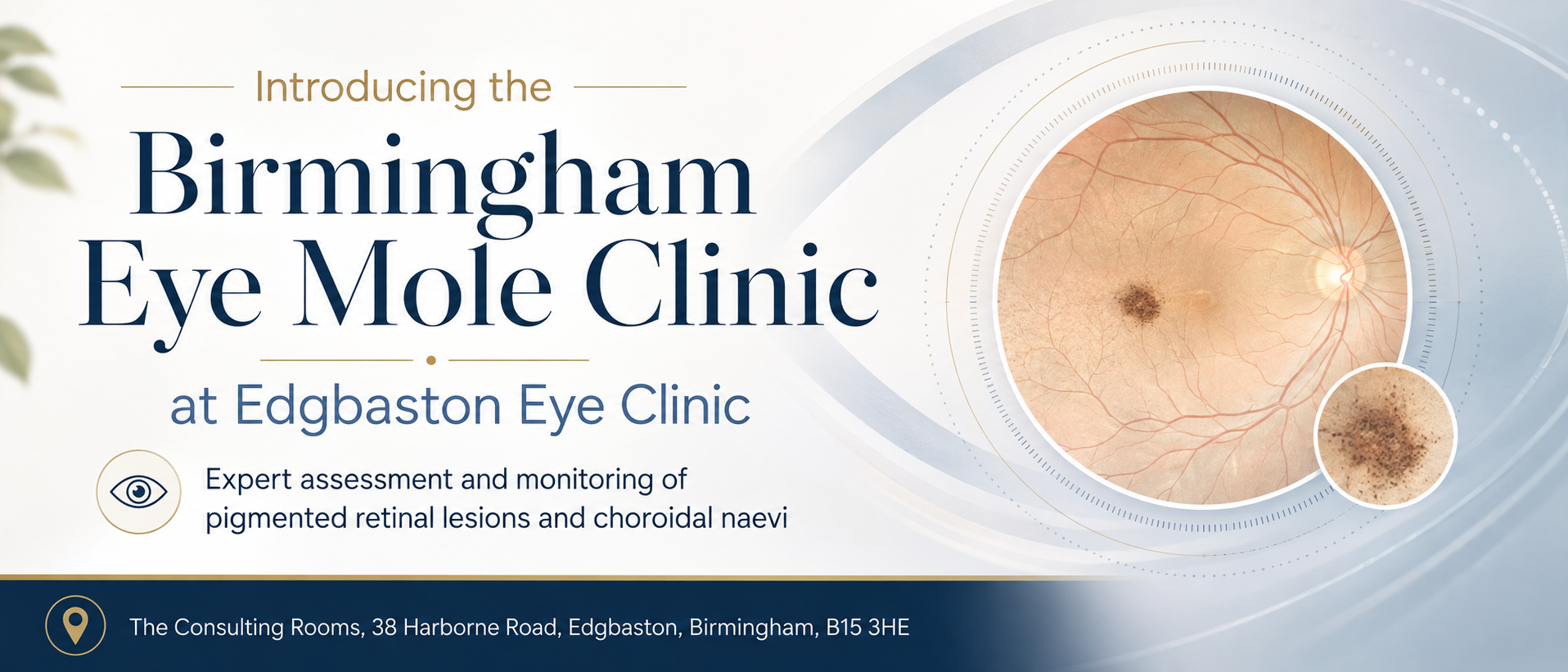
Edgbaston Eye Clinic is pleased to announce the launch of the Birmingham Eye Mole Clinic, a dedicated service for the assessment and monitoring of pigmented retinal lesions, including choroidal naevi — often referred to as “eye moles”.
The service was launched on 5 August 2026 in response to a growing need for more focused assessment, documentation and surveillance of these lesions outside the hospital setting.
Why create a dedicated Eye Mole Clinic?
Pigmented retinal lesions are relatively common findings during routine eye examinations.
In many cases, they are benign and remain unchanged for years. However, some lesions require closer observation, particularly where there are atypical features or uncertainty about whether the lesion has changed over time.
One of the challenges in routine eye care is that patients are sometimes told they have an “eye mole” but are given very little information about what this actually means.
This can understandably create anxiety.
The Birmingham Eye Mole Clinic has been developed to provide a more structured approach: careful examination, detailed imaging, objective documentation and, where appropriate, ongoing monitoring.
The importance of baseline imaging
When a pigmented lesion is first identified, high-quality baseline imaging can be extremely valuable.
A photograph taken today provides a reference point for future comparison.
This is particularly important because one of the most useful indicators when monitoring a choroidal naevus is whether it remains stable over time.
At Edgbaston Eye Clinic, we use advanced retinal imaging, including ultra-widefield technology, which allows a large area of the retina to be documented in a single image.
This can be particularly helpful when a lesion lies away from the central retina.
Depending on the lesion, assessment may also include OCT imaging, dilated retinal examination and detailed clinical documentation.
Not every eye mole needs hospital referral
One of the reasons for creating this service is to provide a measured approach.
Most choroidal naevi are benign.
The aim is therefore not to refer every pigmented lesion unnecessarily, but to identify which lesions appear reassuring, which require closer surveillance and which should be referred for specialist ophthalmic assessment.
Where appropriate, we use recognised clinical risk-stratification principles, including the MOLES system, alongside clinical judgement and imaging.
MOLES considers features such as mushroom shape, orange pigment, lesion size, enlargement and subretinal fluid.
This helps support a more consistent approach to deciding when observation is appropriate and when referral is required.
A service focused on monitoring, not alarming patients
Being told that there is a “mole” or “lesion” inside the eye can sound worrying.
For that reason, the Birmingham Eye Mole Clinic has been designed around reassurance, explanation and careful documentation.
The majority of patients attending will not have a serious condition.
The purpose of assessment is to understand the lesion properly, record its appearance and establish whether any further action is needed.
Where a lesion appears suspicious or demonstrates features that require further investigation, an appropriate referral pathway can then be arranged.
Who may benefit from the service?
The clinic may be particularly useful for patients who:
- have recently been told they have an eye mole or choroidal naevus;
- have a known pigmented retinal lesion that requires monitoring;
- would like a baseline image for future comparison;
- have previous retinal photographs that can be compared;
- have been advised to arrange periodic surveillance; or
- would like a specialist second opinion regarding a pigmented lesion.
Patients are encouraged to bring any previous photographs, scans or correspondence if available.
Birmingham Eye Mole Clinic at Edgbaston Eye Clinic
The Birmingham Eye Mole Clinic is based at:
Birmingham Eye Mole Clinic
at Edgbaston Eye Clinic
38 Harborne Road
Edgbaston
Birmingham
B15 3HE
Telephone: 0121 726 3199
The Birmingham Eye Mole Clinic forms part of the specialist diagnostic services available at Edgbaston Eye Clinic is led by Mr Don Williams, ACP Ophthalmology and registered clinical specialist.
Patients who have been told that they have an eye mole, pigmented retinal lesion or naevus can learn more about our specialist retinal mole assessment in Birmingham, including the examination, imaging and monitoring process.
For detailed information about eye mole assessment, imaging and monitoring, please visit our dedicated Birmingham Eye Mole Clinic service page.