


Introduction
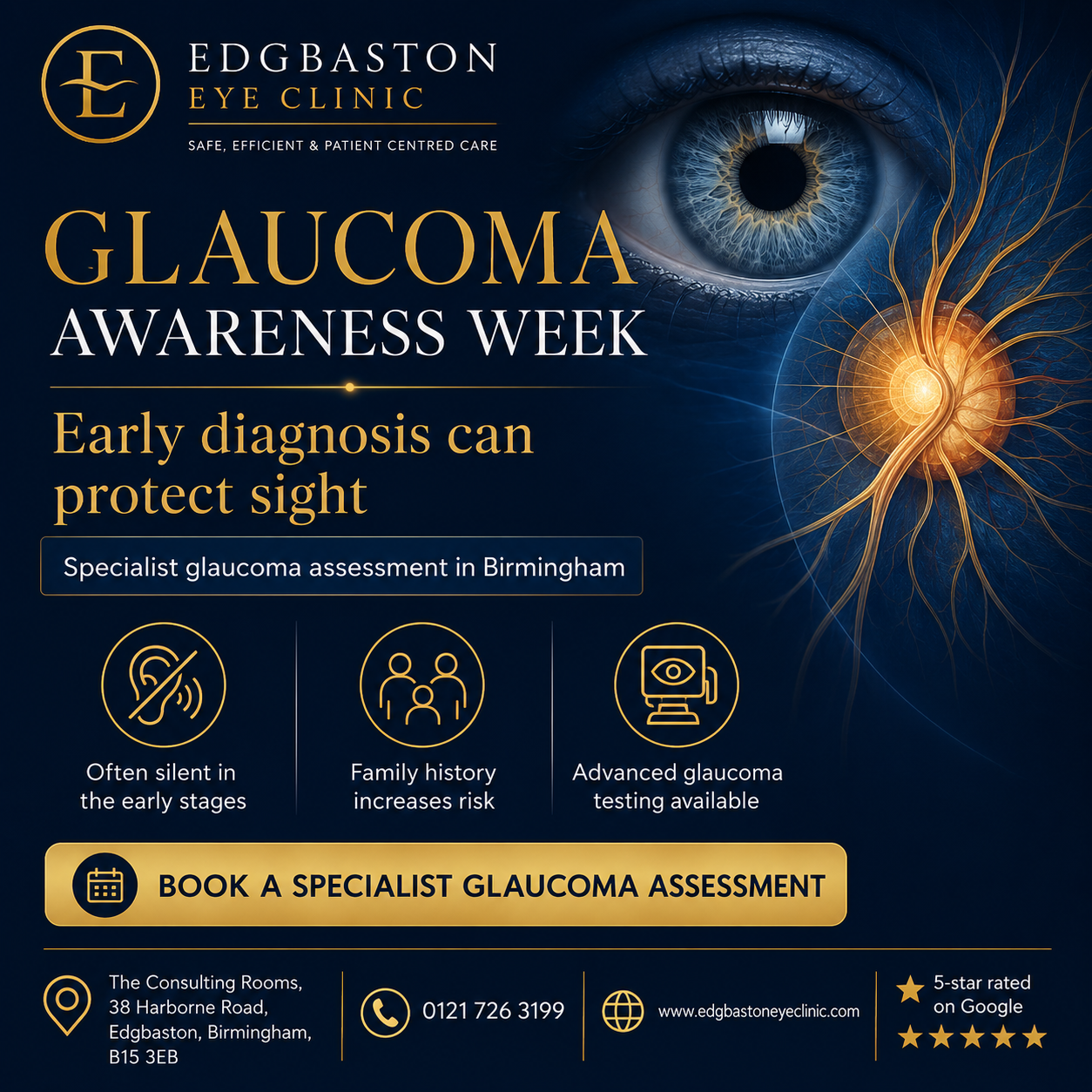
For Glaucoma Awareness Week, Mr Don Williams FCOptom, Advanced Clinical Practitioner in Ophthalmology and Director of Edgbaston Eye Clinic, provides answers to common questions about glaucoma, early diagnosis and the importance of specialist glaucoma assessment.
Glaucoma is one of the most important eye conditions to detect early because it can develop silently. Many people have no pain, no redness and no obvious change in vision in the early stages, yet damage to the optic nerve may already be taking place.
Edgbaston Eye Clinic provides private specialist glaucoma assessment in Birmingham, including advanced OCT glaucoma imaging, visual field testing, eye pressure measurement and specialist clinical interpretation.
Interviewer: Why is Glaucoma Awareness Week so important?
Mr Don Williams:
Glaucoma Awareness Week is important because glaucoma is often a silent condition in the early stages. Many patients feel that their vision is normal, and their eyes may feel completely comfortable, but early damage to the optic nerve can already be happening.
The problem with glaucoma is that once sight has been lost, it cannot usually be restored. The aim is therefore to detect glaucoma early, monitor it carefully and treat it at the right time to reduce the risk of future vision loss.
That is why awareness matters. It encourages patients, especially those at higher risk, to have proper glaucoma testing rather than waiting for symptoms.
Interviewer: What exactly is glaucoma?
Mr Don Williams:
Glaucoma is a group of eye conditions that damage the optic nerve. The optic nerve is the cable that carries visual information from the eye to the brain.
In many cases, glaucoma is linked to pressure inside the eye being higher than the optic nerve can safely tolerate. However, glaucoma is not simply “high eye pressure”. It is really about whether the optic nerve is being damaged.
This is an important point for patients to understand. Some people have high eye pressure and do not have glaucoma. Other people can develop glaucoma even when their eye pressure is not especially high.
Interviewer: So is eye pressure not the whole story?
Mr Don Williams:
Exactly. Eye pressure is very important, and it remains one of the main risk factors for glaucoma, but it is not the whole story.
When I assess a patient for glaucoma, I do not rely on eye pressure alone. I look at the optic nerve, the visual field, the OCT scans, the corneal thickness, the drainage angle of the eye and the patient’s overall risk profile.
Glaucoma diagnosis is about putting the whole picture together. A pressure reading by itself does not tell us enough.
Interviewer: Why do some people get glaucoma?
Mr Don Williams:
There is not always one single cause. Glaucoma usually develops because the optic nerve becomes damaged over time. Raised eye pressure can increase that risk, but other factors also matter.
Age is important. Family history is important. Corneal thickness, ethnicity, short-sightedness, long-sightedness, previous eye trauma and other eye conditions can also influence risk.
The key point is that glaucoma is not the same in every patient. Some patients are at higher risk than others, and some optic nerves are more vulnerable than others. That is why a personalised assessment is so important.
Interviewer: Why does family history matter so much?
Mr Don Williams:
Family history is one of the most important risk factors. If a close relative has glaucoma, especially a parent, brother, sister or child, your own risk is higher.
This does not mean you will definitely develop glaucoma, but it does mean you should take screening seriously. I often tell patients that if glaucoma runs in the family, it is better to be checked early and reassured than to discover the condition late.
Glaucoma can be very manageable when detected early, but it can be sight-threatening when missed.
Interviewer: Why is glaucoma sometimes called the “silent thief of sight”?
Mr Don Williams:
It is called that because many forms of glaucoma cause no symptoms in the early stages.
Patients often expect eye disease to cause pain, redness or blurred vision. Glaucoma usually does not behave like that at the beginning. It tends to affect peripheral vision first, and because the change can be gradual, patients may not notice it.
By the time a patient becomes aware of missing vision, the glaucoma may already be more advanced. This is why proper glaucoma assessment is so important, especially for people with risk factors.
Interviewer: What does a specialist glaucoma assessment involve?
Mr Don Williams:
A proper glaucoma assessment is much more than a simple pressure check.
At Edgbaston Eye Clinic in Birmingham, a glaucoma assessment may include a detailed consultation, eye pressure measurement, optic nerve examination, OCT imaging, visual field testing, corneal thickness measurement, assessment of the drainage angle where needed and retinal imaging where clinically relevant.
The purpose is to answer three important questions: Is glaucoma present? Is the patient at risk of developing glaucoma? If glaucoma is present, is it stable or progressing?
Interviewer: Why is OCT imaging important in glaucoma?
Mr Don Williams:
OCT imaging is very important because it allows us to assess the structures that are damaged in glaucoma in much greater detail.
Glaucoma affects the optic nerve and the nerve fibre layer. OCT allows us to scan these structures and look for patterns of thinning or change. This can be particularly useful when glaucoma is early, when the optic nerve looks suspicious, or when we are monitoring a patient over time.
Visual field testing tells us about function. OCT tells us about structure. In glaucoma, we need both.
Interviewer: What is GMPE OCT?
Mr Don Williams:
GMPE stands for Glaucoma Module Premium Edition. It is an advanced glaucoma analysis platform used with Heidelberg SPECTRALIS OCT.
In simple terms, it gives a more detailed and objective assessment of the optic nerve and the surrounding glaucoma-related structures. It can be especially helpful when the diagnosis is not straightforward or when early glaucoma needs careful monitoring.
The advantage is that it gives us more information than a basic scan. However, like any diagnostic technology, it must be interpreted properly and alongside the full clinical examination.
Interviewer: Is this equipment available at Edgbaston Eye Clinic?
Mr Don Williams:
Yes. At Edgbaston Eye Clinic, we have advanced diagnostic technology for glaucoma assessment, including Heidelberg SPECTRALIS OCT with Glaucoma Module Premium Edition, visual field testing, eye pressure measurement, corneal thickness measurement and optic nerve assessment.
The clinic is based at The Consulting Rooms, 38 Harborne Road, Edgbaston, Birmingham, B15 3HE. We see patients from Edgbaston, Harborne, Birmingham and across the West Midlands for glaucoma assessment, ocular hypertension, glaucoma monitoring and specialist second opinions.
Interviewer: Who should consider booking a glaucoma assessment?
Mr Don Williams:
I would advise a specialist glaucoma assessment if you have been told your eye pressure is high, if your optic nerves look suspicious, if your OCT or visual field test has shown an abnormal result, or if you have a family history of glaucoma.
It is also sensible if you have ocular hypertension, if you are already being monitored for glaucoma, or if you want a specialist second opinion about your glaucoma risk or treatment plan.
Patients often come to us because they have been told something is “borderline” or “suspicious” and they want clarity.
Interviewer: Can glaucoma be treated?
Mr Don Williams:
Yes. Glaucoma can often be treated and monitored very effectively, particularly when it is diagnosed early.
Treatment may include monitoring, eye drops, SLT laser treatment or referral for surgical care in more complex cases. The aim is usually to lower eye pressure to a safer level and reduce the risk of further optic nerve damage.
The treatment plan depends on the type of glaucoma, the level of eye pressure, the appearance of the optic nerve, the visual field results and the patient’s individual risk.
Interviewer: What is SLT laser treatment for glaucoma?
Mr Don Williams:
SLT stands for selective laser trabeculoplasty. It is a laser treatment used to lower eye pressure in suitable patients with open-angle glaucoma or ocular hypertension.
It works by treating the drainage area of the eye to help fluid leave the eye more effectively. It may be considered as a first-line treatment in suitable patients, as an alternative to drops, or as an additional treatment when eye pressure needs better control.
Not everyone is suitable for SLT, so the drainage angle and the full clinical picture need to be assessed first.
Interviewer: How much does a full glaucoma assessment cost at Edgbaston Eye Clinic?
Mr Don Williams:
A full glaucoma assessment at Edgbaston Eye Clinic costs £425.
This includes the consultation and the clinically required scans and tests as part of the full glaucoma assessment. The appointment normally takes about one hour, although this can vary depending on the complexity of the case and the tests required.
It is designed to be a detailed specialist assessment rather than a brief pressure check.
Interviewer: Why is early diagnosis so important?
Mr Don Williams:
Early diagnosis gives us the best chance of protecting long-term vision.
If glaucoma is detected early, we can monitor carefully, start treatment when needed and look for signs of progression before the patient notices symptoms. If glaucoma is detected late, there may already be permanent vision loss.
That is the message I would want patients to take from Glaucoma Awareness Week: do not wait for symptoms if you are at risk.
Interviewer: What is your final message to patients during Glaucoma Awareness Week?
Mr Don Williams:
My message is simple. Glaucoma can be silent, but it is not harmless.
If you have a family history of glaucoma, raised eye pressure, suspicious optic nerves, abnormal scans, abnormal visual fields or concerns about your risk, it is worth having a proper specialist glaucoma assessment.
At Edgbaston Eye Clinic in Birmingham, we use some of the most advanced diagnostic equipment and specialist clinical interpretation to support the early detection and management of glaucoma.
Early diagnosis can make a significant difference in protecting sight for the future.