


Wet age-related macular degeneration (Wet AMD) remains one of the leading causes of severe central vision loss in older adults. The good news is that treatment has advanced considerably over the past few years, with newer medicines offering the possibility of maintaining excellent vision while reducing the number of injections required for some patients.
At Edgbaston Eye Clinic in Birmingham, we believe that patients should understand not only their diagnosis but also the latest treatment developments that may influence future care.
What is Wet AMD?
Wet age-related macular degeneration occurs when abnormal blood vessels develop beneath the macula, the central part of the retina responsible for detailed vision. These fragile blood vessels can leak fluid or blood, leading to distortion of vision, blurred central vision and, if left untreated, permanent central sight loss.
Unlike dry AMD, Wet AMD can progress rapidly, which is why early diagnosis and prompt referral are so important.
Anti-VEGF injections remain the gold standard
The main treatment for Wet AMD continues to be intravitreal anti-VEGF injections. These medicines block vascular endothelial growth factor (VEGF), a protein that stimulates the growth of abnormal leaking blood vessels.
By reducing leakage and preventing further abnormal vessel growth, these injections help preserve vision and, in many patients, improve vision when treatment is started early.
What has changed in recent years?
One of the biggest advances has not necessarily been finding a medicine that improves vision more than existing treatments, but developing treatments that may allow suitable patients to receive injections less frequently while maintaining good retinal control.
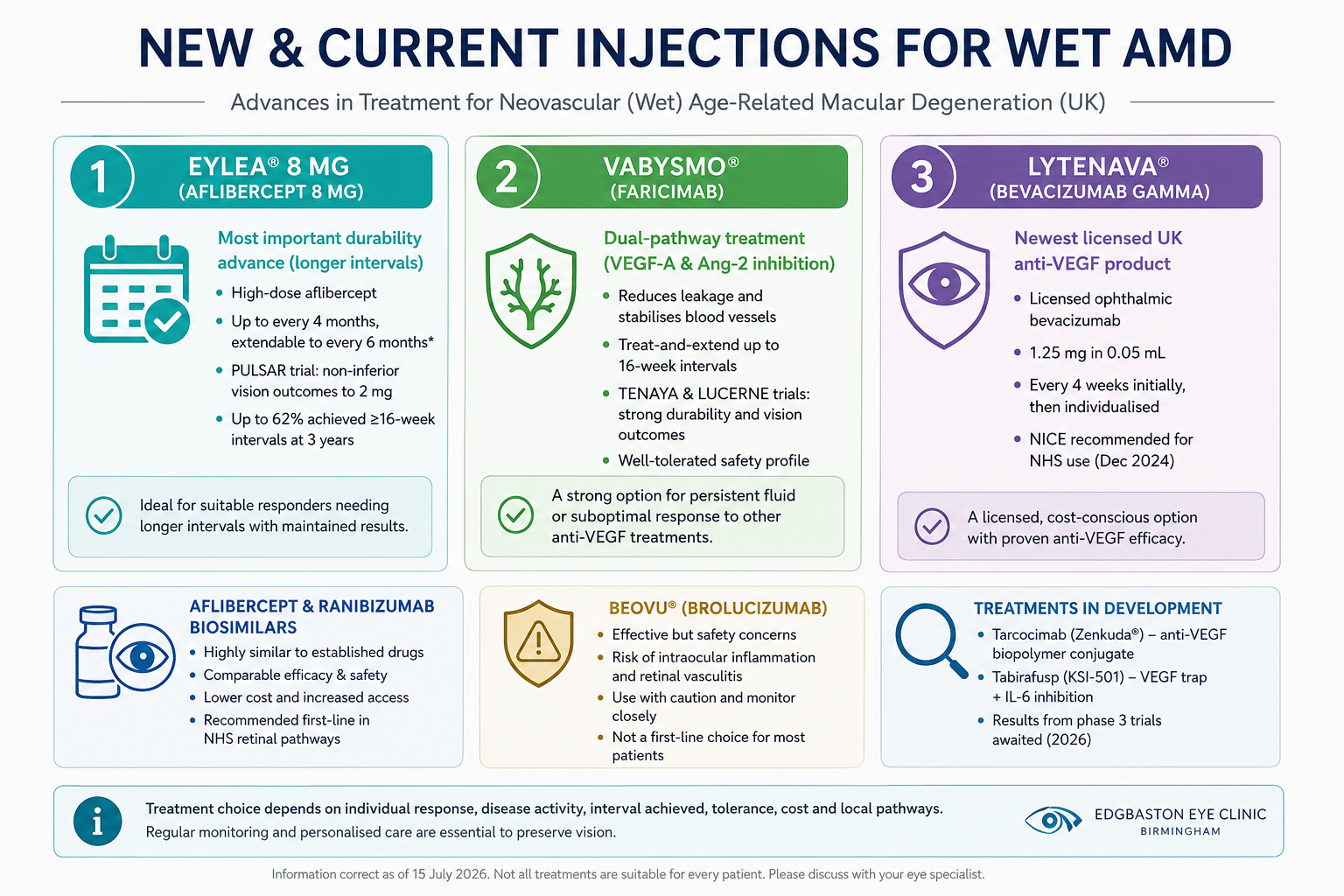
Eylea 8 mg (High-dose aflibercept)
High-dose aflibercept represents one of the most significant recent developments in Wet AMD treatment.
Compared with the original 2 mg formulation, Eylea 8 mg delivers a higher dose of aflibercept, allowing some patients to maintain stable vision with considerably longer treatment intervals.
Clinical studies have shown that many suitable patients can be extended to treatment intervals of up to 16 weeks, while a proportion of carefully selected patients may achieve intervals approaching five or even six months.
For patients requiring frequent injections, this has the potential to reduce treatment burden while maintaining excellent visual outcomes.
Vabysmo (Faricimab)
Faricimab introduced a different approach to treating Wet AMD.
Rather than blocking VEGF alone, it also targets angiopoietin-2, a second pathway involved in blood vessel instability and leakage.
This dual-pathway approach offers another valuable treatment option, particularly for patients with persistent retinal fluid or those who struggle to achieve longer treatment intervals using conventional anti-VEGF therapy.
Many patients in clinical trials successfully reached treatment intervals of 12 to 16 weeks while maintaining vision.
Lytenava (Bevacizumab gamma)
Lytenava is the newest licensed ophthalmic bevacizumab available in the UK.
Historically, bevacizumab has been widely used in ophthalmology as an off-label treatment after being prepared from oncology formulations. Lytenava is different because it has been specifically manufactured and licensed for injection into the eye.
Its arrival is important because it provides a licensed ophthalmic bevacizumab option for suitable patients, although its greatest significance lies in regulation and access rather than representing an entirely new biological treatment mechanism.
Treatment is becoming increasingly personalised
One important message patients should understand is that there is no single “best” injection for everyone.
Some patients respond exceptionally well to aflibercept.
Others achieve better retinal drying with faricimab.
Some require treatment every four to eight weeks, while others can safely extend to much longer intervals.
Modern retinal care is becoming increasingly personalised, with treatment decisions based on visual acuity, OCT retinal imaging, disease activity, retinal fluid and each individual’s response over time.
Early diagnosis remains the most important factor
Although new medicines continue to improve treatment options, the single biggest factor influencing visual outcome is still early diagnosis.
If you notice distortion of straight lines, blurred central vision, difficulty reading or a dark patch affecting your central vision, you should seek urgent assessment without delay.
The earlier Wet AMD is diagnosed and treated, the greater the chance of preserving useful central vision.
Specialist Eye Care in Birmingham
The real Edgbaston Eye Clinic located on 38 Harborne Road, Edgbaston, Birmingham, B15 3HE provides comprehensive specialist macular assessment for patients concerned about age-related macular degeneration, including advanced OCT imaging and detailed retinal examination.
Although anti-VEGF injections for Wet AMD are delivered within specialist retinal services, early diagnosis, prompt referral and ongoing retinal assessment remain essential components of protecting sight.