


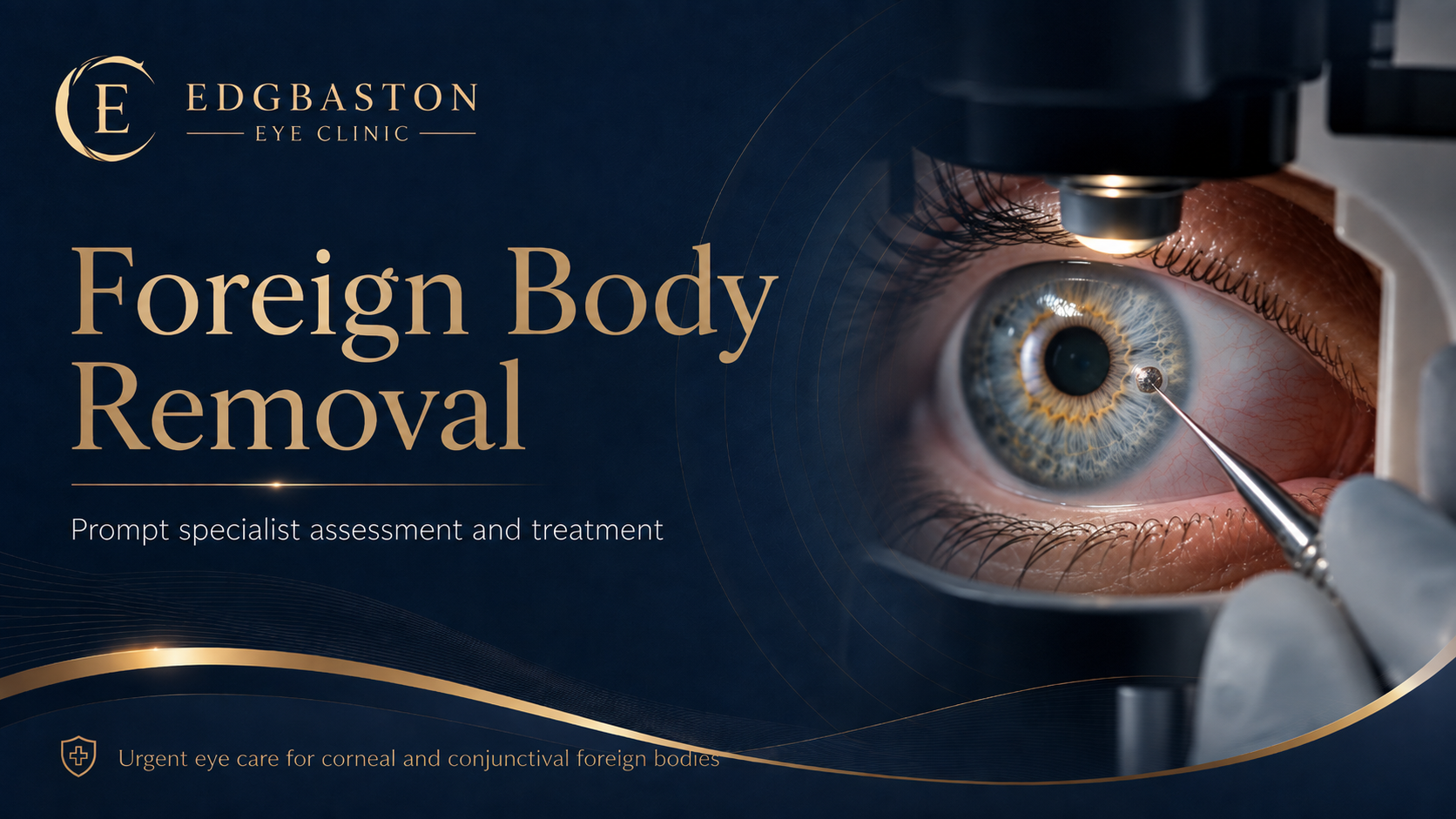
A piece of grit, metal, dust or other material in the eye can seem like a minor problem, but a corneal foreign body can be extremely uncomfortable and occasionally lead to complications if it is not assessed and removed properly.
At Edgbaston Eye Clinic in Birmingham, we provide prompt assessment and removal of suitable superficial corneal and conjunctival foreign bodies, with detailed examination of the eye to check for associated injury.
What is a corneal foreign body?
The cornea is the clear window at the front of the eye. A corneal foreign body occurs when a small particle becomes lodged on its surface. Foreign material can also become trapped underneath an eyelid, where it may repeatedly scratch the cornea every time you blink.
Common causes include:
- metal fragments from grinding, drilling or DIY
- grit, dust or sand
- wood or plant material
- small particles blown into the eye
- workplace or gardening injuries
Because the cornea contains many nerve endings, even a very small particle can cause considerable discomfort.
What does a foreign body in the eye feel like?
Typical symptoms include a persistent feeling that something is stuck in the eye, watering, redness, pain, sensitivity to light and sometimes blurred vision.
Some patients continue to feel something in the eye even after attempting to rinse it themselves. This can happen because the particle has become embedded in the cornea or is trapped beneath the eyelid.
Why should an eye foreign body be examined properly?
Removing the visible particle is only one part of the assessment.
The eye also needs to be examined for a corneal abrasion, inflammation, infection or evidence that the object has penetrated more deeply. Metallic foreign bodies can also leave a rust ring in the cornea, which may require further treatment.
A slit-lamp examination provides a highly magnified view of the cornea and allows the position and depth of the foreign body to be assessed carefully before treatment.
How is a corneal foreign body removed?
For a suitable superficial foreign body, local anaesthetic eye drops can be used to numb the surface of the eye before the particle is carefully removed under magnification.
The eye is then re-examined to make sure the foreign body has been completely removed and to assess any remaining corneal abrasion. Depending on the clinical findings, antibiotic eye drops or ointment, lubricants and appropriate follow-up may be advised.
Most uncomplicated superficial injuries heal well after appropriate treatment. If increasing redness, pain or blurred vision develops afterwards, further examination is important.
When is a foreign body an emergency?
Not every eye injury is suitable for routine foreign body removal.
You should seek urgent hospital eye care or A&E assessment if:
- a sharp object has penetrated the eye
- something has struck the eye at high speed, particularly while grinding, drilling, hammering or using power tools
- there has been a chemical injury
- vision has suddenly deteriorated
- there is severe pain
- you cannot open or move the eye normally
High-velocity injuries are particularly important because a fragment may have passed through the surface of the eye even when the external injury initially appears small. NHS guidance recommends urgent medical assessment for penetrating and high-speed eye injuries.
Should I try to remove it myself?
If loose dust or grit enters the eye, gentle rinsing with clean water may help.
However, you should not rub the eye or attempt to remove an object that appears embedded or has penetrated the eye.
Repeated rubbing can worsen a corneal abrasion, and attempting removal without adequate magnification can cause additional injury.
Foreign Body Removal in Birmingham
If you have something stuck in your eye, persistent grittiness following an eye injury or a suspected superficial corneal foreign body, Edgbaston Eye Clinic provides specialist urgent eye assessment in Birmingham.
The eye can be examined carefully under high magnification to determine whether a foreign body is present, assess the cornea for damage and provide treatment or onward referral where appropriate.
Prompt examination is particularly important when symptoms persist after rinsing the eye or when pain, redness, watering or light sensitivity develops.
Edgbaston Eye Clinic
The Consulting Rooms
38 Harborne Road
Edgbaston
Birmingham
B15 3HE
Tel: 01217263199
info@edgbastoneyeclinic.com
Mr Don Williams FCOptom
Advanced Clinical Practitioner (Ophthalmology)