


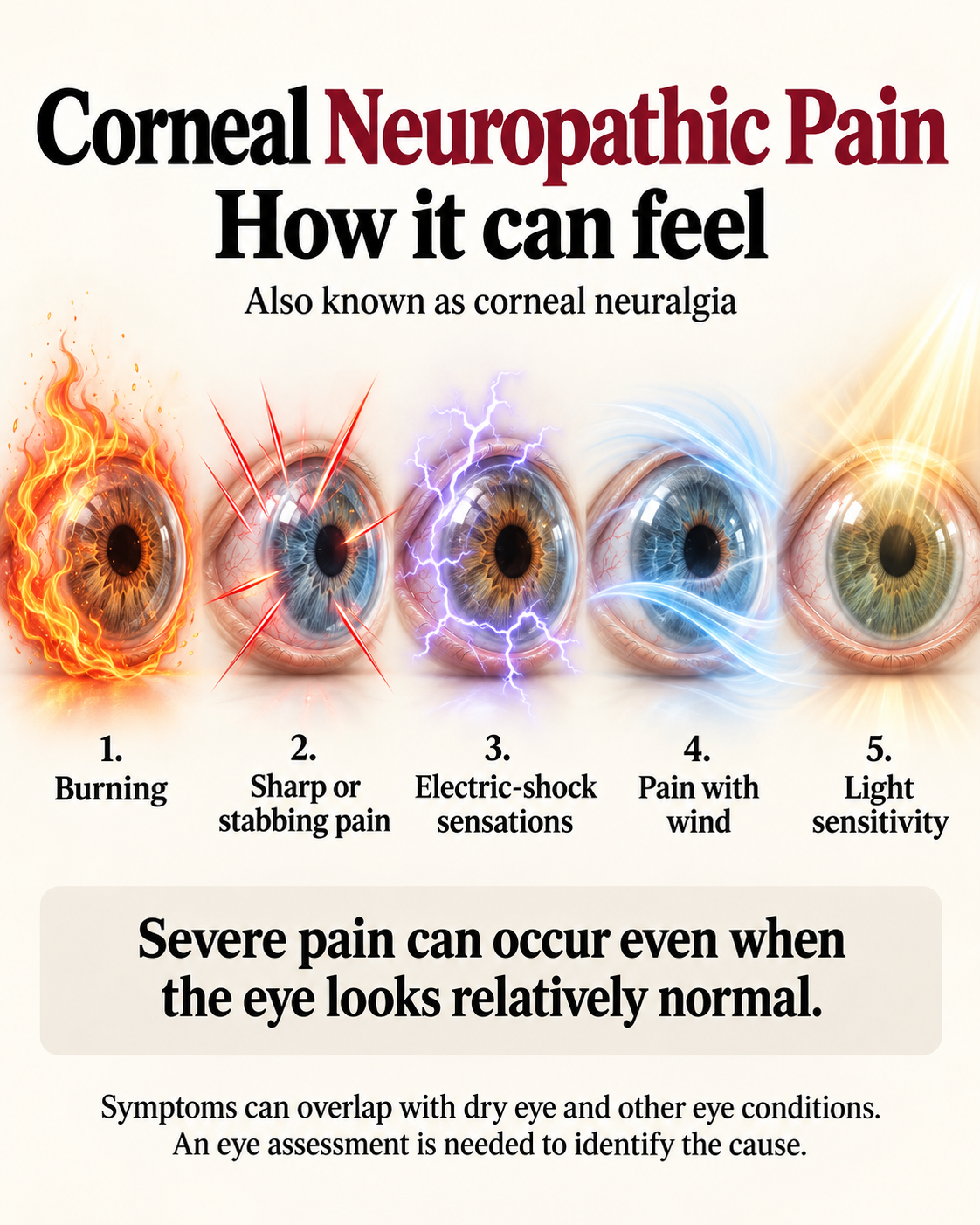
Corneal neuropathic pain, sometimes referred to as corneal neuralgia or neuropathic corneal pain, is a complex and often poorly understood cause of persistent eye pain.
Unlike many eye conditions, the severity of the patient’s symptoms may bear surprisingly little relationship to what can be seen during a conventional eye examination. A patient may describe intense burning, stabbing or electric-shock sensations, yet the surface of the eye can appear relatively normal.
This apparent mismatch between symptoms and clinical signs is one of the reasons corneal neuropathic pain can be difficult to recognise.
Why can the cornea produce so much pain?
The cornea is one of the most densely innervated tissues in the human body. Its sensory nerves form part of the ophthalmic division of the trigeminal nervous system and normally provide an important protective function by detecting mechanical, chemical and thermal stimuli.
When these nerves become damaged or their signalling becomes abnormal, the pain system itself can become sensitised.
This can occur through peripheral sensitisation, where damaged or regenerating corneal nerves become excessively responsive, or through central sensitisation, where repeated nerve signalling alters pain processing within the central nervous system.
Some patients have elements of both.
This distinction helps explain why something normally harmless, such as a breeze across the eye or exposure to ordinary light, can become remarkably uncomfortable.
What does corneal neuropathic pain feel like?
Patients do not all describe the condition in the same way.
Typical descriptions include burning, stinging, stabbing or shooting pain, electric-shock sensations, pressure, foreign-body sensation and marked sensitivity to wind, light or temperature. Photophobia can be particularly troublesome. Some patients experience spontaneous pain even when nothing appears to be touching or irritating the eye.
In neuropathic pain, two concepts are particularly important.
Allodynia means experiencing pain from something that would not normally be painful, such as light or moving air.
Hyperalgesia describes an exaggerated response to something that would ordinarily cause only mild discomfort.
These features can provide important clues that the problem extends beyond conventional ocular surface dryness.
Why can the eye look normal despite severe pain?
This is one of the most difficult aspects of corneal neuralgia for both patients and clinicians.
Neuropathic pain reflects abnormal processing within the sensory nervous system. The severity of pain therefore does not necessarily depend on the amount of visible corneal damage.
Research describes patients experiencing considerable ocular pain, burning and photophobia despite relatively limited findings on routine examination. This has historically contributed to delayed diagnosis in some patients.
The absence of dramatic clinical signs does not automatically mean that the symptoms are insignificant.
Is corneal neuropathic pain the same as dry eye disease?
No, although there can be considerable overlap.
Dry eye disease itself can affect corneal nerves and chronic ocular surface inflammation may contribute to peripheral sensitisation. Some patients therefore have both dry eye disease and neuropathic corneal pain.
One clinical clue is when pain and sensitivity appear significantly greater than the degree of ocular surface disease would normally explain, particularly when conventional dry-eye treatment has produced limited improvement.
This is why simply labelling every patient with burning or uncomfortable eyes as having “dry eye” can sometimes miss an important part of the underlying problem.
What can cause corneal neuropathic pain?
Corneal nerve dysfunction may follow a number of ocular insults. Reported associations include chronic ocular surface disease, corneal trauma, contact lens wear, previous refractive or cataract surgery, infectious keratitis and previous herpes simplex or herpes zoster eye disease. Systemic conditions associated with neuropathic mechanisms may also contribute in some patients.
The history is therefore extremely important. Establishing what happened before the pain began can sometimes provide the most useful diagnostic clue.
How is corneal neuropathic pain diagnosed?
There is currently no single test that conclusively diagnoses corneal neuropathic pain, and there are no universally accepted diagnostic criteria. Diagnosis therefore depends on careful history-taking, examination of the ocular surface and exclusion of other causes of eye pain.
Corneal sensitivity testing and an anaesthetic challenge can sometimes provide additional information. Improvement following topical anaesthetic suggests that a significant component of the pain is arising peripherally from the cornea. Persistent pain despite surface anaesthesia may suggest a greater central component, although the distinction is not always absolute.
In vivo confocal microscopy (IVCM) can image the corneal sub-basal nerve plexus and may demonstrate abnormalities in nerve morphology or density. However, these findings must be interpreted cautiously. Current evidence does not support using an individual IVCM feature, including so-called microneuromas, as a stand-alone diagnostic test.
Why is a comprehensive eye examination important?
Eye pain has many potential causes.
Before attributing symptoms to neuropathic pain, conditions such as significant dry eye disease, recurrent corneal erosion, keratitis, inflammation, infection and other anterior-segment or intraocular disease need to be considered.
The objective is therefore not simply to ask “Is the eye dry?”, but to understand the relationship between the ocular surface, corneal nerves and the patient’s pain experience.
That distinction can fundamentally change how the condition is approached.
Can corneal neuropathic pain be treated?
Treatment can be challenging and usually needs to be individualised according to the underlying cause and whether peripheral or central sensitisation predominates.
Management may involve treating coexisting ocular surface inflammation or dry eye, addressing identifiable corneal pathology and, where appropriate, considering treatments directed towards neuropathic pain mechanisms. More complex centralised pain may require collaboration with other medical specialties.
Current reviews emphasise that the evidence base remains limited and that a multidisciplinary approach can be valuable in difficult cases.
The important point is that corneal neuropathic pain is not simply severe dry eye and there is rarely one treatment that is appropriate for every patient. Currently, there isn’t a cure for neuropathic pain.
Corneal Neuropathic Pain Assessment in Birmingham
Persistent burning, stabbing eye pain, unusual sensitivity to wind or light, or pain that appears disproportionate to the findings on a routine eye examination deserves careful investigation.
At Edgbaston Eye Clinic in Birmingham, patients with complex ocular pain can undergo a detailed ophthalmic and ocular surface assessment to investigate potential corneal, inflammatory and neuropathic causes of their symptoms. Where more specialised assessment such as in vivo confocal microscopy is appropriate, onward investigation can be considered.
Understanding whether pain is predominantly ocular-surface related, neuropathic, or a combination of the two is an important step towards developing an appropriate management strategy.
Mr Don Williams
ACP (Ophthalmology)
Director and Lead Clinician Edgbaston Eye Clinic
Edgbaston Eye Clinic
The Consulting Rooms
38 Harborne Road
Edgbaston
Birmingham
B15 3HE
Tel: 01217263199
E-mail: info@edgbastoneyeclinic.com